Chapter 7:
Voices in the Walls
Baz hunched over the battered desk in the station’s back office, the single fluorescent tube above her sputtering like an old man’s cough—unsteady, reluctant to give out entirely, yet too stubborn to die. Her skin, yellowed by its sickly light, glimmered with a greasy sheen of midnight sweat, and she was aware, at a remove, of her own smell: cigarettes, old paper, the faint tang of bleach. The police station at this hour was a mausoleum, echoing with the ghosts of ink and bureaucracy. With the blinds drawn and only the steady tick of the clock and the soft, arrhythmic hum from the fluorescent tube, Baz could almost imagine herself the last living person in the world—except for the tape recorder on the desk, its reels spinning out a faint, persistent whine into the thick air.
She’d long ago lost count of how many times she’d sat here, alone in the pulsing dark, listening to the endless repetition of voices pressed into plastic. Mac and Silas had drifted home hours ago, leaving her only a cold mug of instant coffee and a lump of their collective exhaustion. But Baz couldn’t tear herself free. Not logic. Not hope. Just that restless ache behind her ribs, a gnawing compulsion, whispering: You missed something.
She pressed rewind, let the tape snap to attention, then play. Again. Rewind. Play. Her own voice on the tape, flat and formal: “State your name for the record.” The static hissed, the tape stuttered, and then Sarah Franklin’s frail voice emerged from the soup of noise, so thin and trembling it seemed likely to snap under its own weight. “Sarah Franklin. I… I was in the girls’ dormitory, I told the other officer that already.” She didn’t sound like a survivor recounting tragedy. She sounded like a child rehearsing lines, desperate to get them right. Every time Baz replayed this stretch, she found herself holding her breath, as if she could will Sarah to say one more thing, confess the secret she’d withheld from every adult in her life.
Tonight, something new. Baz’s hands, always steady, quivered beneath a skein of caffeine and adrenaline. She closed her eyes, letting the tape’s hiss fill her head. For what felt like an eternity, nothing. Then: a soft inhalation, too deliberate to be random, a breath drawn not by the girl but by something hovering just outside the range of human hearing. A pregnant pause. Then a second voice—a child’s voice, tinny and distant, as if recorded through several feet of concrete or water. It was barely more than an exhalation, yet unmistakable, a shivering susurrus that made every hair along Baz’s arms stand at unhappy attention.
“I don’t want to forget. Please don’t let me forget.”
Her heart launched itself against her ribs, a small and frantic animal. Baz jerked upright, breath snagging in her throat like a bird trapped behind glass. The pen slipped from her hand and rolled away, unnoticed. She stabbed at the rewind button, breathless, palms slick with fear, and pressed play. The tape responded with the ordinary whine, Sarah’s voice, the static, but now the second voice was gone—erased, or never there to begin with. Baz toggled back and forth, replaying the moment in increments, each time more certain she hadn’t imagined it. The voice wasn’t a record. It was a presence, lurking at the crumbling edge of memory.
A knock at the glass door startled her, and she nearly sent the cassette player tumbling to the ground. Mac stood in the hall, his frame doubled and darkened by the smudged, wire-mesh window. She waved him in, not trusting herself to speak.
He crossed to her with the clumsy gentleness of a man who’d once played football but now feared breaking things, including himself. Mac peered at the clattering cassette player, then at Baz’s face. “You look like hell, B. When’s the last time you slept?”
She ignored the question, gesturing instead at the machine. “Listen. Tell me what you hear.”
He cocked his head, brow furrowed, as the tape hissed to life. Sarah’s voice, then the silence, then—if you strained—maybe a ghostly whisper, or just an artifact of the bad tape. Baz watched his eyes, saw the moment his skepticism flickered and died. “That’s a second kid,” Mac said softly. “Shit.”
Baz nodded. “It wasn’t on the original. I would’ve heard it.”
“Maybe a bleed-through? An overlap from another tape?” Mac offered, but his voice was hollow.
“No.” Baz let the denial sit. “It’s new. Or… It’s here.”
Mac shifted his weight, eyes darting to the corners of the room. He’d never say it, but the evidence room unnerved him. “Might be worth checking the source, then. The choir school. We can pull the old case files and see if any of the other girls had—” He trailed off, unwilling to put words to the shape of his thought.
Baz’s mind was already moving ahead, mapping out the night. “We could go now. I don’t want to wait until morning.” She felt the urgency in her bones, a tidal pull. “I need to hear what they heard.”
Mac nodded, resigned. “Let me call Silas. He’ll want to be there.” He left, the door sighing closed behind him. Alone again, Baz cued up the tape, played the segment on loop. Each time, she thought the whisper grew clearer, as if the act of listening coaxed it further out of hiding.
She stared at the ceiling, letting the cassette run, and for a moment she imagined the station’s drop ceiling thinning to nothing, exposing the black girders of the sky. Something waited up there, hunched and patient, feeding on old tape and memory. She pressed her palms flat to the desk and shuddered.
***
The drive to St. Lydia’s was silent, save for the rattle of Mac’s old Crown Vic and the low hum of the heater. Silas sat in the back, shrouded in his own silence, face illuminated by his phone’s cold blue light. Baz watched the city slip by, the sodium glare of streetlights giving way to the emptiness of the industrial outskirts, then the weed-choked strip of road leading to the old school.
If St. Lydia’s ever glowed with the warmth of music and children, it was long gone. The skeleton of the building loomed at the horizon, three stories of charred brick and blown-out windows. Once, the place had housed not only a choir school but an overflow wing for the county orphanage—a detail Baz had discovered in a footnote and couldn’t shake, as if the ghosts of both institutions had commingled in the ruins.
They parked under a streetlamp, the light barely touching the gaping blackness of the school. Baz led, flashlight in hand, scarf twisted tight around her neck. The gate was gone, torn down by looters or weather. A sign still hung askew on the fence, the word “CONDEMNED” barely visible under layers of spray-painted obscenity.
Inside the threshold, the building inhaled them. The rot and ruin had a personality, a living ferocity, as if years of neglect had produced a kind of sentience. Baz felt it at her back, urging her deeper. The lobby’s mosaic floor was buckled and overgrown with creeping moss, the ceiling a patchwork of rotted tiles and exposed beams. Their footsteps echoed, oddly muffled, as if the walls themselves absorbed the intrusion.
They walked in silence, Mac trailing Baz by a step, Silas gliding behind, his phone now pocketed. Baz’s flashlight beam danced along the walls, catching the glimmer of a brass plaque: “Founded 1894, For the Uplift of Orphaned Souls.” The words seemed both laughable and tragic.
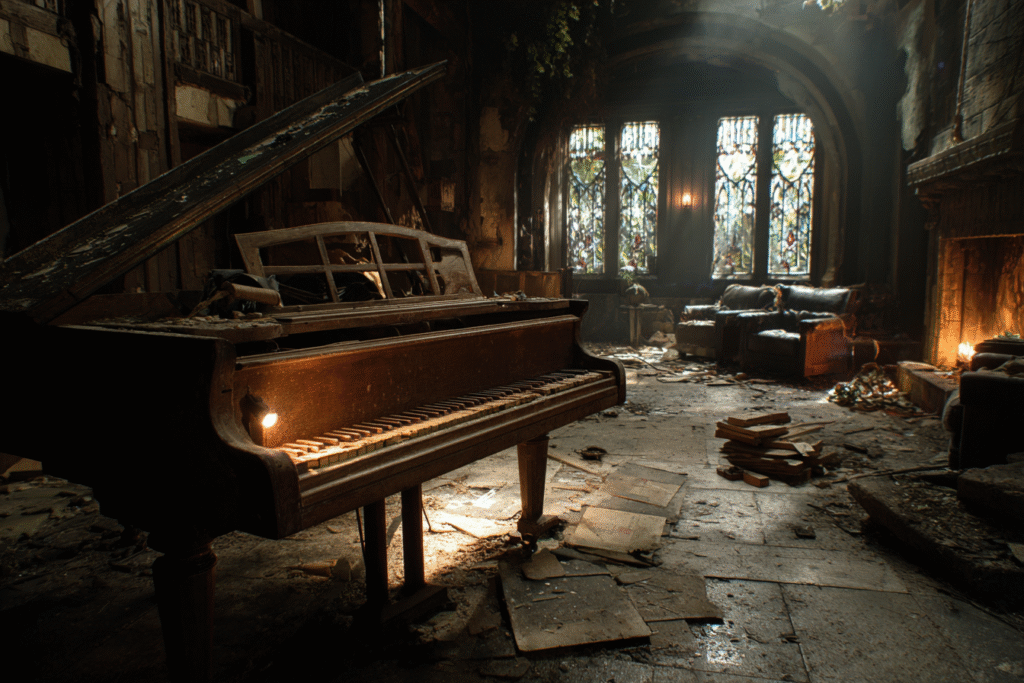
The music room was easy to find. Its door, blackened by smoke, hung loose on rusted hinges. Inside, the remains of a grand piano slouched in the center, the lid warped and keys peeled back like a mouth mid-scream. Burnt hymnals were piled in sodden mounds along the baseboards, their pages fused together, unreadable.
Baz circled the piano, trailing her fingertips along its scorched flank. Beneath the keyboard, she found what she’d been looking for: a scatter of names, carved and gouged into the wood. Lucy. Tamika. Sarah. The script was frantic, childish, some letters so deeply incised that the wood splintered around them.
Mac hovered at her shoulder, reading over her. “They left their names. Maybe a roll call, maybe a memorial.”
Baz shook her head. “Look closer.”
Mac did, squinting. “Commands. ‘Sing louder.’ ‘Don’t stop.’ What the hell.”
Baz knelt, brushing her fingers along each groove. The marks were layered, some names overwritten again and again, as if obliteration was a kind of worship. She closed her eyes, trying to summon the voices, but only the cold pressed in.
A crash from across the room startled them all. Silas had found a boarded-up closet, the door nailed shut with strips of warped wood. He looked at them, sheepish, but his voice was steady: “Bet there’s something in here.” Mac pried the boards
excellent piece Mangus